Oregano
Tuesday 9 September 2025

It’s about 2 PM. It’s hot, just under 30ºC, but the fresh sea breeze is pleasant and comfortable. I walk past a row of parked cars and enter the taverna. It’s called Oregano. Under the awning, all the tables are empty, but inside the taverna itself about half the tables are occupied. The chairs are made of wood, and the tables are covered with sheets of brown paper.
I look for a waiter and ask if I can sit down near the window. He nods and goes to get me a menu. The menu is big, pages and pages long — each item has a name and description in Greek, English and Italian.
While I’m leafing through the menu, the waiter approaches and asks me if I want to come with him to see the day’s specials. I say yes.
I follow him through the restaurant and into a massive dark kitchen. A lot of people are working here. There’s a row of bains-marie under glass, and behind them, skewers of roasting meat. The waiter rattles off a list of about a dozen daily specials — osso bucco with farfalle pasta, meatballs in tomato sauce, moussaka, roast lamb, Greek fish, beef stew, meatballs again, beef in risoni (orzo? kitharaki? I didn’t hear), chicken burgers, I can’t remember the rest. Perched on a shelf above the bains-marie there’s a plate of the meatballs with mashed potato.
“Can I have the meatballs?” I ask.
“Mashed potato, rice or pasta?”
“What’s best?”
He gestures at the plate on the shelf. “Mashed potato,” he says.
“I’ll have the mashed potato then.”
I go back to my table and and wait. The waiter brings me a plate of pita bread and some horrible chilled red wine in an anodised aluminium jug. The man at the next table lights up a cigarette. Surprisingly, I find this charming.
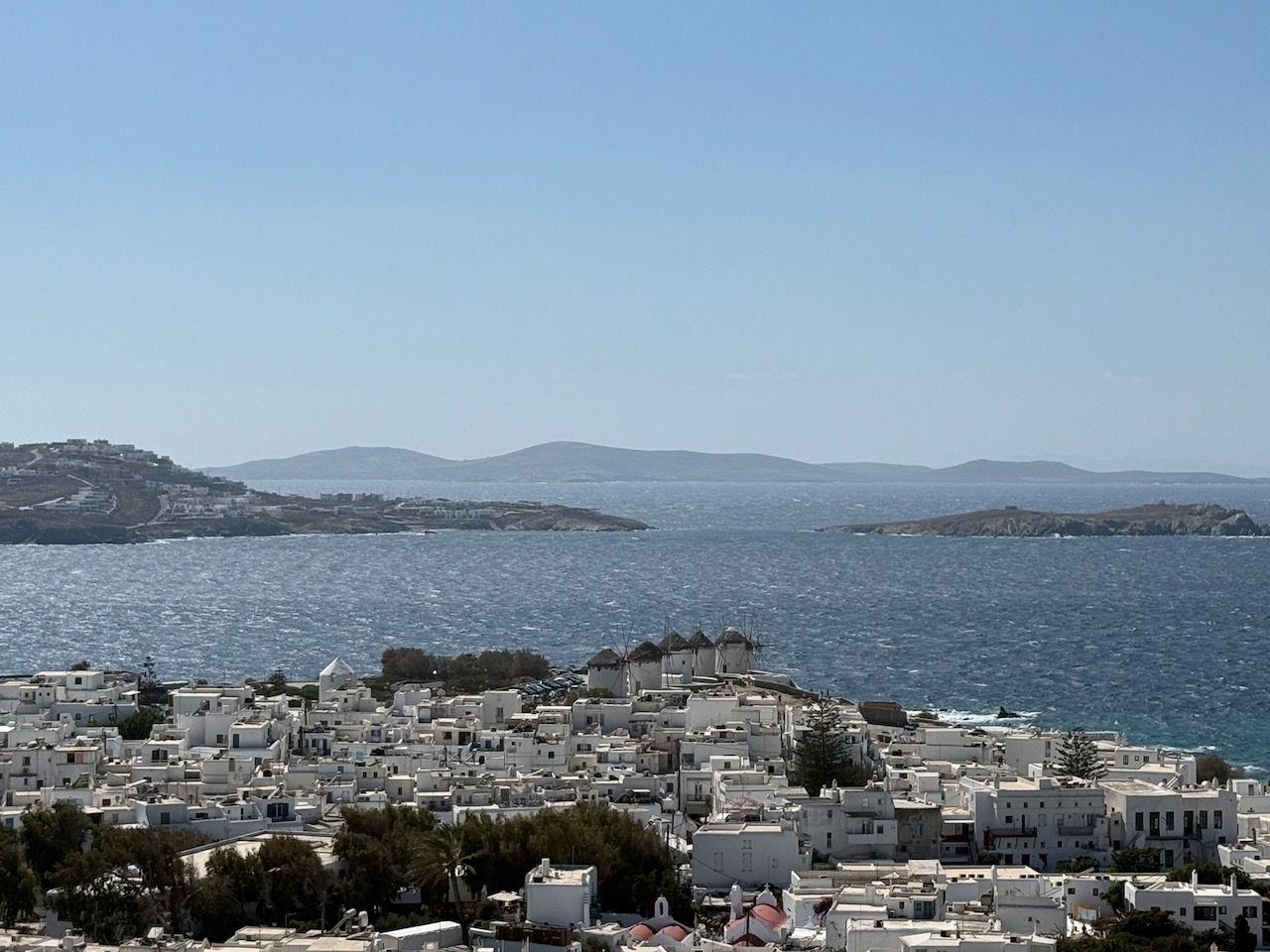
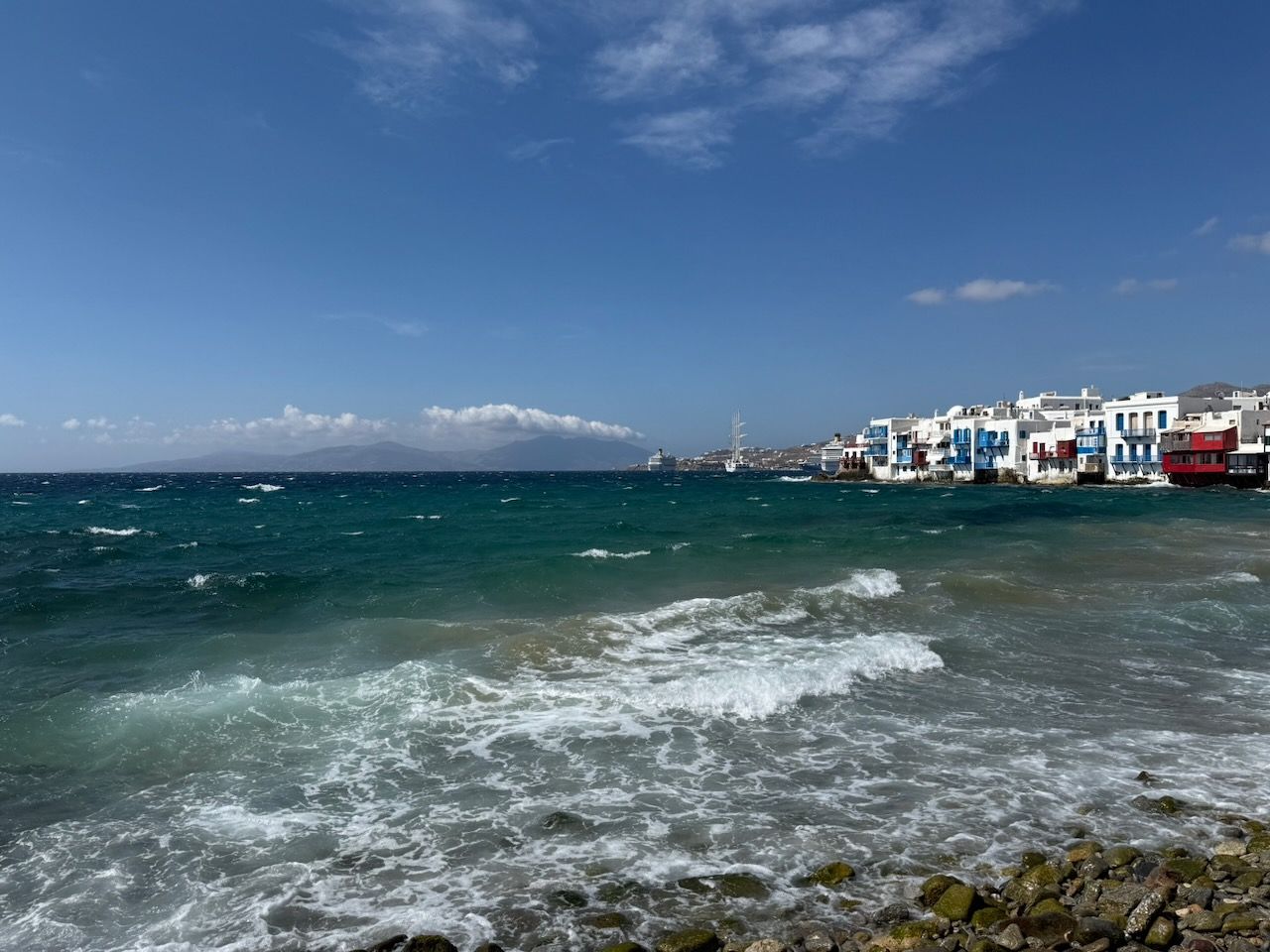
I arrived in Mykonos yesterday and went straight down to the old town, which is called Hora.1 It’s a maze of twisty little passages, all alike — white walls, blue accents, stone pathways. A lot of shops selling expensive designer clothes and jewellery. Little secluded bars. It was much fancier than the old town in Paros, fancier than Antíparos, fancier than Naoussa.
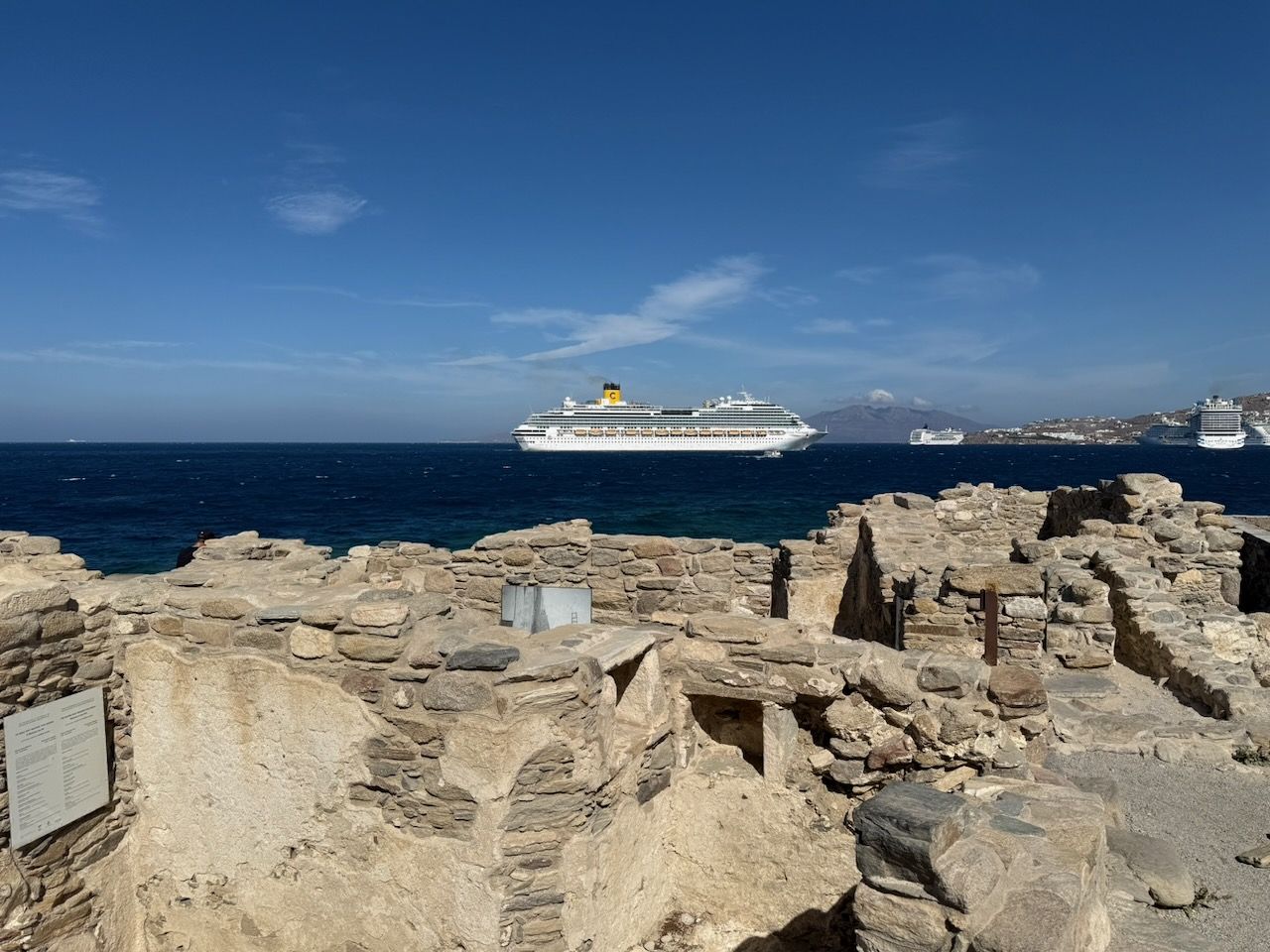
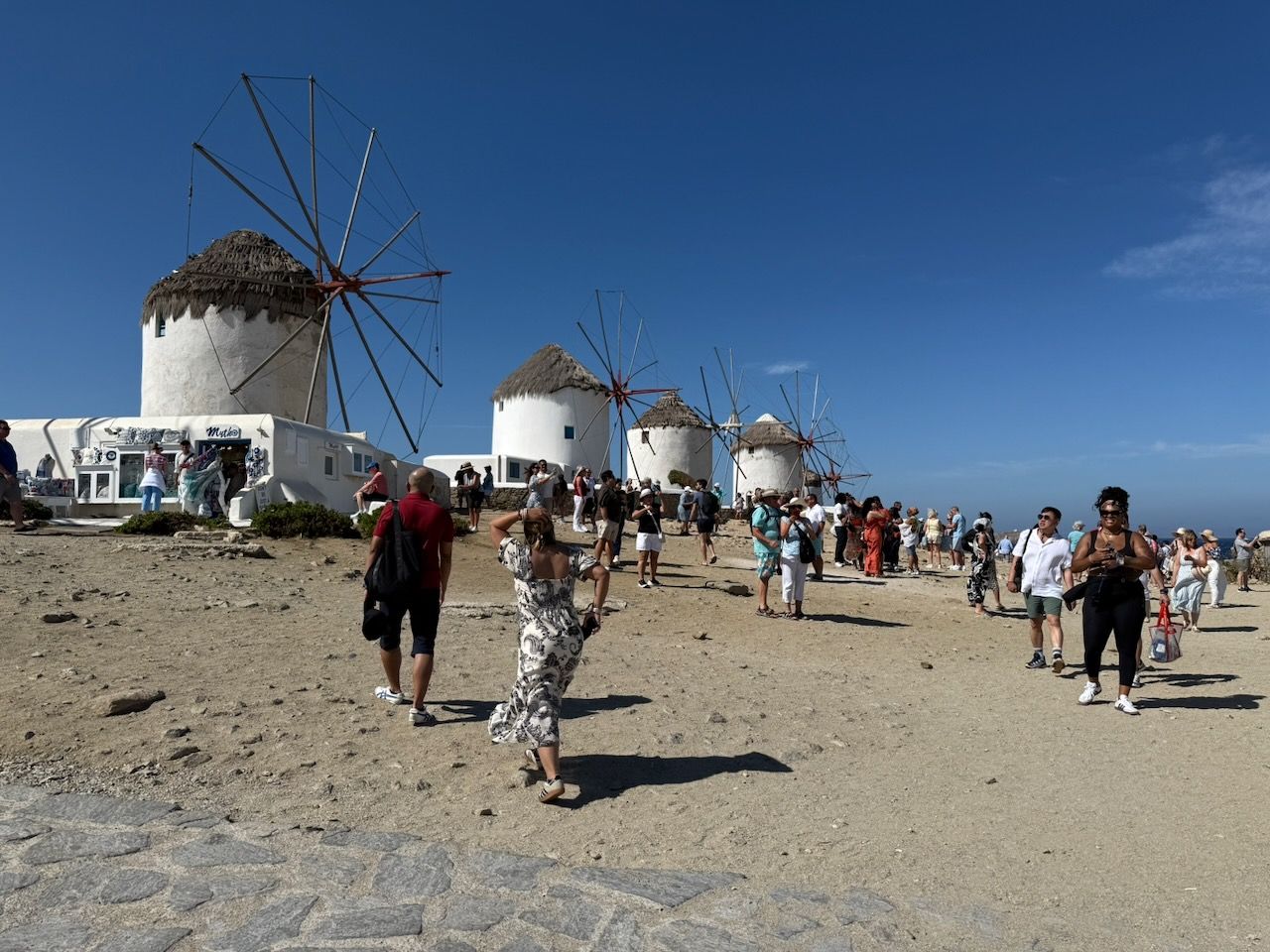
And crowded! There were two huge cruise ships in the port when I got there, and so the streets everywhere are full of people. Older people, mostly, but a few gay men who weren’t saving their strength for the evening’s clubbing.
I checked out a few restaurants: pretty, with extensive outdoor seating and elegantly typeset menu boards, and dishes all about twice the price of the food in Parikia.

While I’m waiting for the meatballs to arrive, I look out the window at the shop across the street. It’s a supermarket. I should really go to the supermarket to get some breath mints, and maybe just to see what it’s like.
The sign on the wall of the supermarket calls it a Βασιlόπουλος, which I suppose is like a megastore, only royal.2 The text underneath it is trickier: και του πουλιού το γάλα. And the milk of something? I ask Google Translate. And bird’s milk as well. I look the up the phrase and find an article in Greek about its origin. It means that the shop sells absolutely anything you might want. Even bird’s milk. (It’s possible that πουλί comes from the Latin word pullus, which means a baby bird.)
The food arrives. It’s savoury and delicious. It even manages to complement the terrible wine.
Accommodation in Mykonos is expensive, unsurprisingly, and so I booked a cheaper hotel about a mile away from Hora, further up the hill. The area is kind of suburban, with busy roads and roundabouts, and lots of big shops — toy shops, pet shops, medical centres, local restaurants like Oregano, bakeries, fruit shops. All in low, white flat-roofed buildings like the buildings in Hora, but without the heritage theme park vibe.
And unlike the cramped and grimy hotel room in Ermoupoli, this is a suite, with a spare bedroom, a kitchenette, and a balcony with a table and chairs and a sun lounge. And the shower is huge, with reliable hot water and proper satisfying water pressure.
Tomorrow morning, I’m going down to Hora and the Old Port to catch a boat to the nearby island of Delos. It’s the birthplace of Apollo and Artemis, and the ruins there are extensive and important: temples, a theatre and the Terrace of the Lions. It’s been on my bucket list for a long time.
On the way back to my hotel afterwards, I’ll pick up my laundry and then check out the supermarket. Bird’s milk. Why not?
Now that I’m in Naxos, I discover that its main town is just called Hora (or Chora) as well. In Classical Greek, χώρα just means place or position (or country); in modern Greek a town gets called Χώρα if it has the same name as the island that it’s on. ↩︎
Here’s what Maria has to say about Basilopoulos: “By way of supermarkets, Basilopoulos and Sklavenitis are the Colesworths of Greece, being given a run for their money by new player My Market, as well as Lidl.” ↩︎